
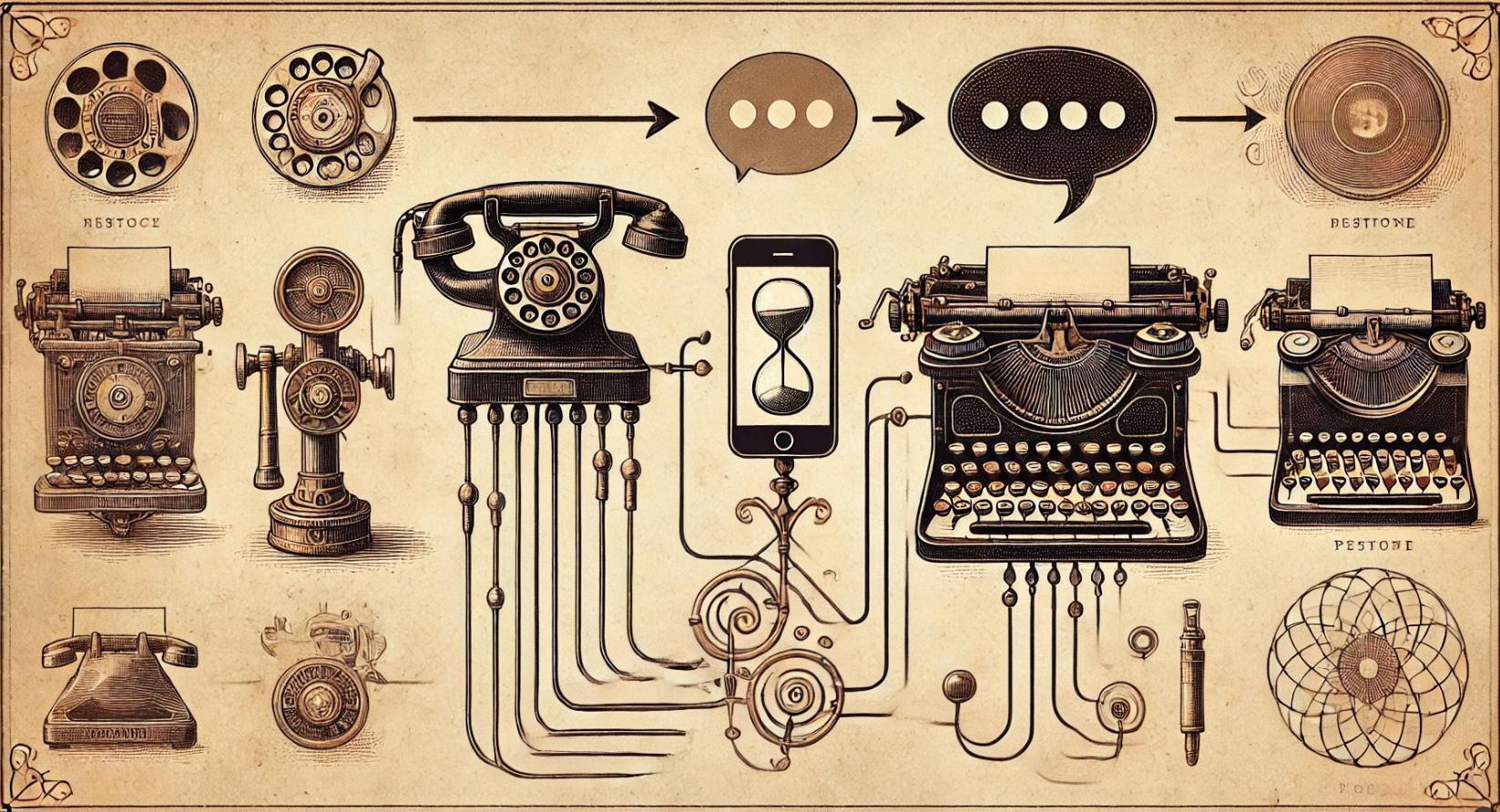
A brief history of chat, from BBS to AI
Before services like WhatsApp or iMessage existed, text-based communication was already evolving. In the 1980s, Bulletin Board Systems (BBS) and Internet Relay Chat (IRC) set the groundwork for the immediate messaging we now consider standard. It’s comparable to the change from sending a letter by horseback to quickly sending a text adorned with emojis. If military leaders of ancient times had to depend on carrier pigeons, how might they respond to a stream of ‘seen’ notifications in a group chat during battle?
Throughout the years, chat interfaces have undergone several important stages:
- 1990s – Instant messaging and SMS: Services like AOL Instant Messenger (AIM) and Microsoft Messenger made real-time text chatting popular among internet users. At the same time, SMS (Short Message Service) became widely used, enabling mobile phone users to exchange brief texts. During this period, customer service departments also started using SMS for straightforward interactions, like checking account balances or reporting problems.
- 2000s – Social media integration & SMS support centers: Platforms such as Facebook Messenger and Skype transformed digital chatting into a common social activity. Companies began to adopt more sophisticated SMS support, providing options like “Press 1 to report a lost card” and leading to structured and interactive engagements.
- 2010s – Mobile-centric chat: Messaging applications such as WhatsApp, iMessage, and Telegram focused on the chat experience designed for mobile devices.
- 2020s – AI-Driven conversations & autonomy: With the emergence of powerful language models like ChatGPT, chat experiences became more aware of context, efficient, and human-like. Users now can issuing natural language commands “Find me a hotel in Manhattan for tonight” that AI agents could understand, process, and fulfill automatically. This signifies a new period where chat entails not just conversation but also performing intricate tasks, functioning almost like a personal digital assistant.
Redefining communication norms
Chat interfaces have significantly changed the way we communicate. Instead of engaging in lengthy face-to-face conversations, many individuals, particularly younger people, now favor brief, quick text messages. This transformation has resulted in:
- New social dynamics and asynchronous communication: The introduction of features like “read receipts”, “typing indicators”, and “online statuses” has established fresh expectations. If someone leaves you on “seen” it can be interpreted in various ways, often leading to anxiety or overthinking “maybe she stoped loving you, oh oh wait, she’s typing ?”. The continuous presence of online and typing notifications encourages an unwritten rule of near-instant responses.
- Integration of visual elements through emojis, GIFs, stickers and memes: Chat applications have blurred the distinction between written and visual communication. Emojis, GIFs, and stickers contribute additional layers of meaning but can also lead to misunderstandings. Cultural references and internet-savvy expressions, like some suspicious fruit meanings, have evolved into a variant of dialect within our texting culture.
- The emergence of voice communication: Voice messages and voice assistants introduce a new dimension to digital chats, offering convenience in hands-free scenarios and enhanced accessibility. Instead of replacing textual communication, voice has developed into a supportive method that feels more personal while remaining at a distance. Before calling is better to send a voice note, anything but calling.
- Mixing professional and casual communication styles: Applications such as Slack, Microsoft Teams, and Discord serve for both work-related and social interactions, resulting in a blurred line between professional and personal communication styles. It has become commonplace to share a meme with a supervisor in one channel and then draft a formal project proposal in the next exchange.
While chat provides speed and convenience, the absence of physical cues, such as tone, facial expressions, and posture, can lead to misunderstandings. Consequently, our “digital etiquette” is continually adapting, balancing brevity, courtesy, and clarity in often complex ways.
The psychological effect of constant connectivity
Instant messaging offers distinct advantages, such as keeping in touch with family and friends worldwide, organizing events, and responding to clients promptly. However, being continuously accessible through text messages also introduces several challenges:
- Expectations of immediate availability: Seeing a message can create a mental impulse to reply right away. If you choose not to respond, anxiety may arise, either for you, as you might worry about seeming unresponsive, or for the sender, who may question if you’re upset. This tension can heighten stress levels and lead to “digital fatigue” where the incessant need to reply disrupts your tranquility.
- Validation Loops and Social Pressure: Elements like “read receipts” and “typing…” notifications can encourage compulsive behavior to frequently check your device. Such alerts can foster addictive cycles of seeking validation, with individuals gauging their social value based on the speed of responses and the volume of messages received, contributing to mental health issues like anxiety and feelings of isolation.
As noted by Hampton & Wellman (2018), concerns about technology often focus on how these digital interactions might undermine traditional community bonds and interpersonal connections.
- Impact on productivity and focus: Frequent notifications disrupt focus. Studies indicate that shifting attention to check a notification can take over 15 minutes to return to the original task (Mark, Gudith, & Klocke, 2008). Throughout the day, these disturbances accumulate, substantially decreasing productivity while increasing stress levels.
Chatbots and AI-Enhanced conversations
Organizations have adopted AI-driven chat systems to lower costs, improve user support, and customize customer interactions. A notable case is Klarna (The e-commerce site) which collaborated with OpenAI to create an AI-powered support agent, resulting in the layoffs of hundreds of service agents in the first year of implementation, as reported by a 2022 company statement and several news sources, including TechCrunch (see References). While the approach provided efficiency and round-the-clock service, it also highlighted a larger trend:
- Efficiency vs workforce disruption: Automated chat solutions can address common inquiries more economically and swiftly than human staff. Nonetheless, the implementation of these technologies raises ethical and economic questions, what occurs when automation extensively displaces human employment?
- Sustainability concerns: AI solutions necessitate substantial computing resources, data centers, and specific hardware. These systems require considerable energy and produce ample heat, raising environmental concerns regarding the sustainability of rapidly growing AI initiatives.
- Balancing human touch and machine precision: Not everyone values automated replies. Complex or sensitive matters often demand empathy that AI currently cannot provide. Many specialists argue that AI should serve as a tool for enhancing efficiency in routine tasks, while humans manage more intricate, emotionally sensitive, or strategic decisions.
- Ongoing bias and misinformation issues: Early AI chatbots were infamous for providing inaccurate or biased responses. Developers must consistently enhance training datasets, emphasize diversity, and apply oversight protocols to address these challenges. Without such interventions, there is a risk of perpetuating harmful stereotypes or disseminating misinformation.
Chat in the workplace
Chat-based platforms like Slack, Teams, and Discord have reshaped the professional environment:
- Enhanced collaboration: Real-time group chats can replace slow email threads, accelerating decision-making processes and fostering teamwork.
- Blurred boundaries and risk of burnout: The same platforms that enable quick communication can also bind employees to work around the clock. Some companies implement “quiet hours” or restrict after-hours notifications to alleviate burnout, recognizing that the same tools that enhance productivity can also disrupt work-life balance. A personal decision not to check email or the work slack group is not enough.
- Interference with deep work: For tasks requiring deep concentration, constant alerts can be disruptive. Once in Flow state a meaningful but funny meme can f&·$3= up the magic.
The Future: Chat as the foundation of Human-Computer Interaction
As we look forward, chat interfaces are set to emerge as our main method for controlling and communicating with devices. With advances such as AI agents and beyond make me think of the following:
- AI assistants as key hubs: Virtual assistants are becoming increasingly conversational, ultimately transforming into proactive agents that predict our needs and provide solutions, such as scheduling appointments or alerting you about sales on items you’ve viewed.
- Preference for natural language over buttons and menus: Conventional user interfaces may become less relevant compared to voice and chat-based requests. Picture being able to personalize a car’s settings by simply “talking” to it, or placing an order for your favorite meal at a fast-food kiosk through a brief text interaction instead of selecting options and avoiding to understand a new information architecture of an app.
- Influencing Daily Routines: Wearable technologies like the Humane AI Pin and innovative devices like “the Rabbit” (a pioneering wearable that integrates AI interactions seamlessly into daily routines) are designed to integrate chat interfaces into our lives even further, they’re not there yet, but it’s not a question of whether they or another company will be able to get there It’s more about when. The chat interface acts as an invisible but constant assistant, quietly managing life behind the scenes.
As this change progresses, chat evolves from a minor feature of technology to the central platform upon which technology functions.
Chat interfaces have become an integral part of modern life, revolutionizing our connections, work, and perspectives on technology. On one hand, they facilitate instant global communication, improve efficiency, and provide powerful AI-driven functionalities. On the other, they require us to adapt to new social dynamics, address mental health and data privacy issues, and consider ethical dilemmas regarding automation’s effect on employment.
As the chat interface transitions from a simple text box to a comprehensive digital companion, it is essential for designers, policymakers, and users to work together to create a future where technology genuinely promotes human welfare and maintains authentic relationships. Therefore, it is crucial to find a balance: utilize the advantages of chat and AI to better our lives, while remaining conscious of their significant societal effects.
References list:
- Hampton, K. N., & Wellman, B. (2018). Lost and Saved… Again: The Moral Panic about the Loss of Community Takes Hold of Social Media. Oxford University Press. Link
- Mark, G., Gudith, D., & Klocke, U. (2008). The Cost of Interrupted Work: More Speed and Stress. CHI 2008 Proceedings. Link
- Pew Research Center. (2021). Mobile Technology and Home Broadband 2021. Link
- Grand View Research. (2022). Chatbot Market Size & Analysis, 2021-2028. Link
- TechCrunch. (2022). Klarna Layoffs and AI Integration. Link